
| Related pages: |
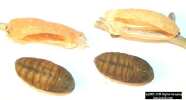
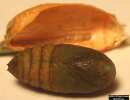
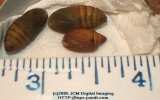
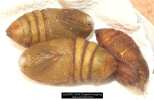
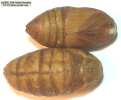
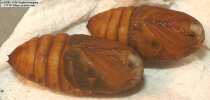
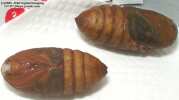
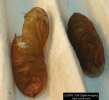
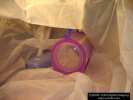
These images were taken on 8-22-2005 and show the pupae along with the cocoon shells. There is no sign of development yet.

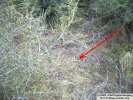
On September 30, 2005, I was fortunate enough to find a wild albofasciata cocoon on Ceanothus greggii. As expected, the cocoon was slightly less bright yellow than the lab-raised specimens due to the summer weathering but still much more conspicuous than one might expect in the wild. Exhaustive searching of other C. greggii in the area have not resulted in a single additional cocoon. I have to conclude that finding this one was a matter of blind luck.
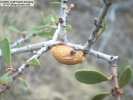
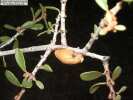
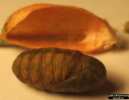
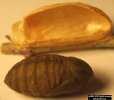
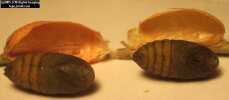
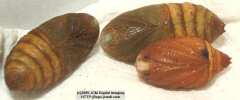
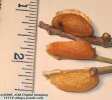
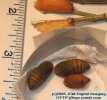
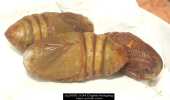
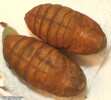
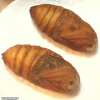
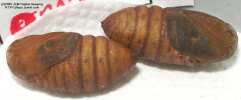
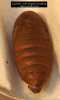
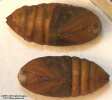
After opening it, I discovered a live pupa inside. The antennae seemed quite a bit larger than the other two from the San Jacinto mountains. After side-by-side comparison, I determined that the other two are both female. This was very good news and improved the chances of getting at least one mating, and raising a brood from ova. A few shots of the cocoons, pupae, are shown below. A scale shows just how tiny these moths really are. 10-01-2005
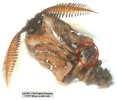
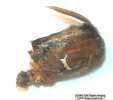
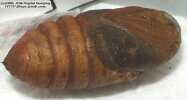
Note the dark spot on the tip of the male's left forewing. It is apparently a defect, injury or deformity that would be a likely cause of its unfortunate demise just prior to eclosure.



Up to this point the females had been kept indoors, and while still being exposed to the natural daylight photoperiod via a nearby window, they were NOT exposed to the outside temperature changes.
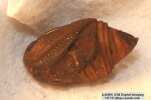
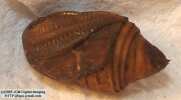
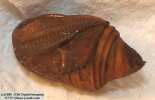
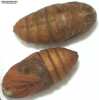
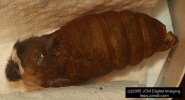
On 10-24-2005, the female pupae had progressed little, while the male was looking very ripe and was apparently holding until conditions were just right. Just a few days earlier, he was observed wiggling (a wing flapping motion, not the rotary abdominal twist, typical of pupae) inside the pupal shell, as if struggling to break free but unable to. It's very possibly that this was his attempt to eclose but due to the "defect" (dark spot on forewing) he was physically unable to.
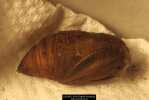
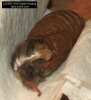
By 11-16-2005, it had appeared that the male was not going to eclose. The pupal shell was very thin and crisp, and easily flaked away with soft forcepts. The shell was carefully removed bit-by-bit (just in case!) to reveal a dead and mostly dried pre-emergence adult male. Still soft enough to be pliable but mostly dessicated. The dark spot at the tip of one wing (circled) noted earlier now appears to be a deformity which probably caused the problem. It appears that the wingtip and upper adbomen are actually fused at that location. There is obviously internal injury as well and the whole area probably did not develop properly.
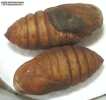
Meanwhile, the females were changing to a yellowish color and becoming less translucent. A dark vein pattern was also developing in the wing cases. They were obviously beginning development, rather late.

On 11-23-2005 one of the females was finally starting to show some serious wing pattern. The other one was lagging a bit but still displayed the light pinkish colored spots where the wing features would be. The top 4 pictures were taken at 7am. By 7pm the same night, there had been rapid progress. The next 3 pictures show the same pupae only 12 hours later!
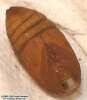
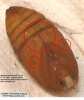

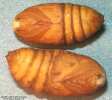


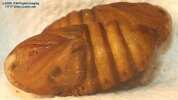
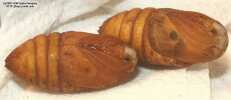
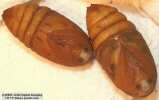
11-25-2005 (8am)
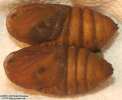

11-26-2005 (8am)
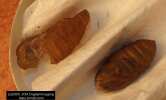
On 12-03-2005 (9am), pupa #1 (the larger one on the right) had finally seperated the wing case area but the wings themselves were still dark... Pupa #2 looks similar but the wings still appeared dark and "sealed" to the pupal case. Note the difference in the abdomen shape and size. Pupa #1 shows lengthening and expansion as compared to #2, which is 2-3-days behind in development.
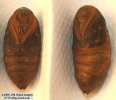
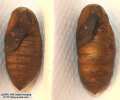
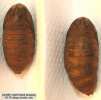
When these photos were taken on 12-04-2005 at 9am, Pupa #1 looked much different. The wing case areas, although seperated from the pupal shell yesterday, were now much lighter and appeared to have "dried" overnight. The photos below clearly show the difference between wing case seperated and not.
Top 4 images: Pupa #2 (on the left) still has "sealed" wing cases and is about 2-3 days behind Pupa #1 (right). The adult inside is now essentially free of the amber-colored pupal shell and can emerge as soon as internal development is complete and ambient conditions are suitable.
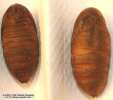
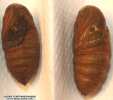

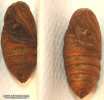

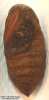
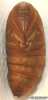
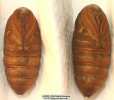
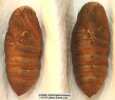
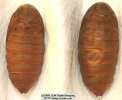
12-7-2005: To see if the pupae could be encouraged to eclose indoors, they were treated to simulated natural environment temperature profiles for several days up to this point. They were kept outside (garage) at night between 40°F to 50°F. In the morning (7a) they were brought inside and allowed to acclimate to the mid 60s. Around 10am, they were placed under a compact fluorescent desk lamp and slowly brought up to the mid 70's where they were kept until about 4 or 5pm. After that, the light was shut down and they returned to ambient (mid 60s) for an hour or so before finally being returned to the garage for the night.
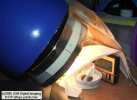
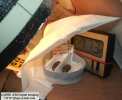
The controlled temperature setup is shown below. Note that a barrier (tissue) is placed between the light and the pupae to help reduce the intense light while allowing the warmth to slowly build in the semi-enclosed space. A digital thermometer allows monitoring of the micro-environment. Several pieces of paper taped to the light provide a shroud to help trap heat. The temperature can easily be adjusted by moving the light closer or further away in small amounts.

On 12-7-2005 at 1:10p, pupa #1 began making strong porpoise-like movements for several seconds, followed by a short rest. After several cycles of movement and rest, she managed to crack the pupal shell and crawled free. The process took about 4 minutes, but if she were still inside her cocoon this process would have certainly taken longer. [See the 2006 Saturnia albofasciata emerging video on YouTube!] She was placed onto the bottom of a long twig and allowed to crawl up until she found a suitable angle to cling. 10 minutes later she began expanding her wings, which longer to complete than expected - almost 2 hours. Even after 2 hours the very tips of the wings were still a little droopy but it was apparent she was done. Unlike most Saturniids, she did not appear to extend her ovipositor/scent gland noticeably. A pictorial sequence is shown below...
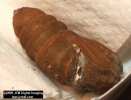
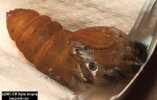


Unlike the previous female which was larger and had a particularly big abdomen (and probably large egg load), this female eclosed and fully expanded her wings within about 75 minutes. The photos below show the event...


She Completed expanding her wings and began scenting noticably by about 4pm. She was placed in a scent-collecting apparatus where she continued to scent until the desklight was turned off at 9:30pm. Interestingly, she became active almost immediately, and within 5 minutes was exhibiting flight/ovipositing behavior, much like the previous female did under similar conditions the previous day. She was placed into an envelope and into the refrigerator to see if she might resume scenting on subsequent days. After 3 days at 37°F, she was returned to ambient on the morning of day 4. She made some interesting abdominal stretching movements as she warmed up and was observed periodically throughout the day until about 6pm, but did not visibly appear to resume scenting. She may still have been attractive to males. Field testing is needed.
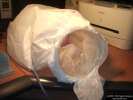
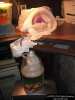
The scent collection rig is shown below. It consists of a medium sized plastic bag containing a small cage (scenting female inside) and a very small air pump. The battery-powered pump comes from a home medical leg pressure-cuff device. A small aquarium air pump could also be used. Both the cage and pump are sealed (not a great seal but good enough!) in the bag. A transparent plastic container is rubber-banded into the bag opening to act as a viewport. The pump hose exits the side of the bag and empties into another deflated bag inside a plastic container. Air with the scent is pumped into the empty bag in the container, which expands and displaces the ambient air in the container, acting like a bladder. When full, the bag is tied closed and stuffed into the container, then sealed with its cap. The plastic container acts as a secondary seal and also protects the inner bag from puncture. Yes, this is mad-scientist type stuff, but if the scent molecules and container integrity last until next year, it could be a great way to attract males! [Note: The collected/stored scent was tested in 2006 and did not attract any of the males present in the testing area.]



08-22-2005 |
10-01-2005 |
10-24-2005 |
11-16-2005 |
11-23-2005 7am |
11-23-2005 7pm |
11-24-2005 8am |
11-25-2005 8am |
11-26-2005 8am |
 11-27-2005 8am |
 11-28-2005 8am |
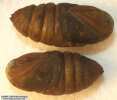 11-30-2005 8am |
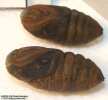 11-31-2005 4:45pm |
12-04-2005 9a |
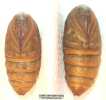 12-04-2005 7p |
12-06-2005 (no time) |
12-07-2005 (#1) |
12-08-2005 (#2) |
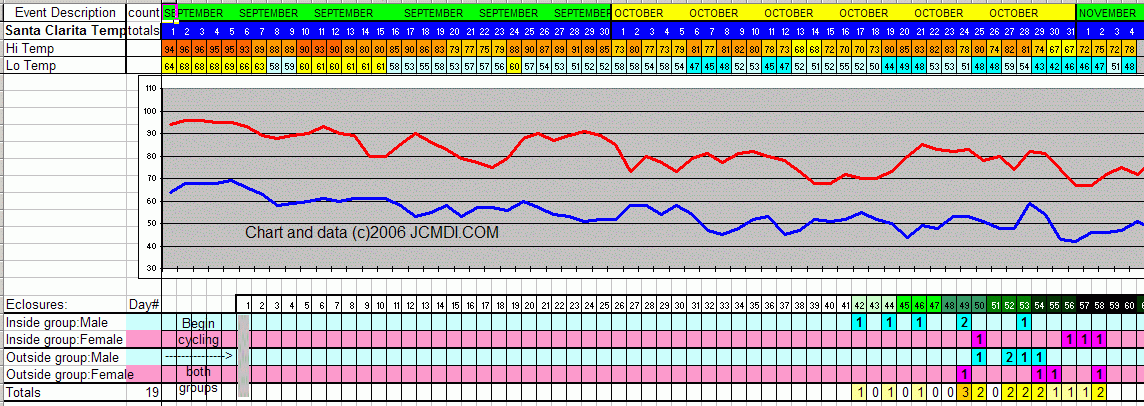
The progress chart below was developed using the data collected from the two females documented above.
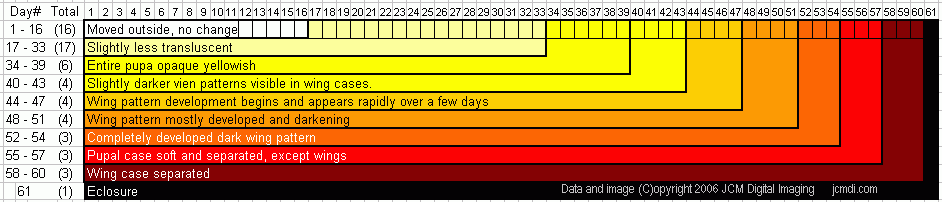
Based on that data, the 19 pupae from the 2006 brood were "triggered" on September 6th, by exposing them to cold (45F - 55F) overnight temperatures from that point on. Their development progressed fairly close to the expected rate. The whole group eclosed between 42 and 58 days of "triggering", with the bulk of them around 53 days, right in sync with the wild flight in late October.
Return To:
 SCV Butterflies |  Main Index Page |
